The North West Highlands Geopark is probably one of the largest geoparks anywhere, comprising 2000 km2 of remote, mountainous and coastal terrain. It was the first European Geopark to be recognised in Scotland in 2004 and was designated by UNESCO as a Global Geopark in 2015. Since then, it has been very successful in delivering […]

The Digne-les-Bains ammonite slab is one of the most impressive geosites of the UNESCO Global Geopark of Haute-Provence and Réserve Naturelle Nationale Géologique de Haute-Provence. Its importance rests on the number of fossils as well as their size and the high quality of the outcrop and its huge potential. It is an important subject for […]

Inventorying and assessing geoheritage is a prerequisite for developing measures to preserve unique geological and geomorphological sites. Several researchers have developed methods for assessing and determining the value of geological and geomorphological sites. Given rapid environmental and climatic changes, it is crucial to improve the state of geoheritage assessment and inventory development. This overview presents […]

The number of geoconservation studies in Costa Rica has been increasing in the last 10 years. The Poás Volcano National Park has been characterized as one of the most visited places in Costa Rica where many tourists come to see one of the most emblematic volcanoes in the country and Central America. This study documents […]

The Spanish Courel Mountains UNESCO Global Geopark has strong educational and touristic resources despite limited preservation of Paleozoic invertebrate fossil assemblages within metamorphic rocks. The paleontological sites are managed by means of their inventory and integration in a Geographical Information System, the construction of virtual 3D fossil models, the creation of a fossil collection exhibition, […]

Colombia boasts extensive geodiversity thanks to complex geological processes that have shaped its landscape over geological time. The eastern region of the country is characterized by ancient rock formations, covered by a substantial layer of sediments, influenced by tectonic and erosive forces. These forces have given rise to unique geoforms that qualify as geosites. Thirteen […]

The Global Boundary Stratotype Section and Point (GSSP) of the Aalenian Stage (base of the Middle Jurassic), was established in Fuentelsaz (Central Spain) by the International Commission on Stratigraphy (ICS) of the International Union of Geological Sciences (IUGS) in 2000. This stratotype is one of the most important geosites of the Molina-Alto Tajo UNESCO Global […]

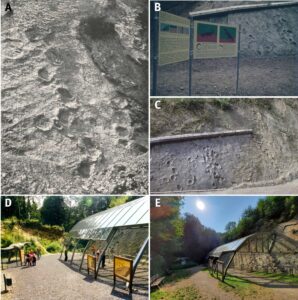
The low level of the Jurassic sea in the area of Bad Essen-Barkhausen (Wiehen Mountains, NW Germany) was a precondition for the migration of a herd of sauropods and theropods through this coastal area about 153 million years ago. The dinosaurs left at least 11 trackways on a single fine-grained siltstone layer and several more […]
For many years, even before it was designated as Las Loras UNESCO Global Geopark, work was carried out to promote and protect the geological heritage of the territory. To this end, an innovative model of governance was introduced, involving local people in the management of heritage by means of citizen participation processes and Geo-volunteering. This […]

The Ammonitico Rosso is one of the most studied as well as most unusual facies developed in the Tethys Ocean, mainly during the Jurassic. This calcareous to marly-calcareous facies was typical on high seabeds seawards from the main platforms and emerged lands, sites where fine sediments accumulated discontinuously, while invertebrate animals tunneled the sea bottom […]