
Exploration of oil and gas seepages employing geochemical techniques has helped to discover new hydrocarbon resources across the world. Oil and gas exploration techniques had substantial advancements in the late 2000s. Numerous geophysical and geochemical techniques have been created and are constantly improving along with the advancement of digital technologies. Geochemical techniques are being used […]

The lack of good knowledge about geomechanical parameters can be a big challenge in drilling new oil and gas wells or stimulating existing ones since geomechanical parameters are needed for safe and stable drilling. In this work, elastic parameters were determined from well logs using empirical correlations. The software used were Schlumberger Petrel 2017 and […]

Decreasing the void ratio of soil due to static compression causes soil structure changes and developing anisotropic structure. This phenomenon as a common result causes the development of anisotropic permeability ratio (kh/kv or rk). When the soil shows a high void ratio, it generally contains macropores that have the most effect on the permeability, soil […]

Carbonate rocks are considered more suitable for construction purposes because of their mechanical behavior. The Indus basin of Pakistan hosts substantial carbonates. In the present study, the Jurassic carbonates of Samana Suk Formation in Nizampur Basin of Attock-Cherat ranges are investigated in term of its petrographic, aggregate and mechanical characteristic which shows their suitability for construction industries. The field […]

Calcareous nannofossils are one group of microfossils that use in biostratigraphy studies since the 1950’s and 1960’s. Recently, because of the potential of nannofossil species for age determination, several authors use this fossil-group in the study of Cenozoic sediments and rocks. Here, we present a nannofossil biozonation based on biostratigraphic information from the Sabzevaran section […]

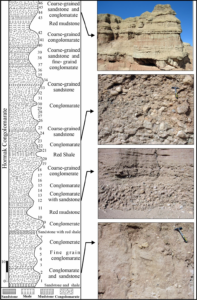
Alveolinids benthic foraminifera, are known as significant biostratigraphic markers, commonly occur in shallow water carbonates of Eocene deposits from Tethyan regions. Twenty-nine species and three subspecies of the genus Alveolina are described from carbonate pebbles of the Hormak conglomerates (Ghargharook section) in northeastern Zahedan (eastern Iran Belt). The Ilerdian and Cuisian chronstratigraphic units of the […]
The Asmari Formation is a thick carbonate sequence in the foreland Zagros Basin that was deposited during the Early Oligocene-Miocene. The Asmari Formation in North Western of Charam, Kohgilooyeh and Boyer Ahmad province was studied in terms of microfacies, sedimentary environment, and sequence stratigraphy. The upper boundary of the section is overlain by the Gachsaran […]

Lower Cretaceous strata in Kopet-Dagh Basin are mostly composed of medium- to thick-bedded limestones with various skeletal (bivalves, foraminifera, algae, echinoderms, brachiopods) and non-skeletal (peloids, ooids, and intraclasts) grains. In this study, two stratigraphic sections of Chaman-Bid and Sorkh-Ghaleh with thicknesses of 247 and 190 m respectively in NE Iran, have been studied in order […]

The Darbandikhan Dam reservoir in NE Iraq is located on soft sedimentary rocks which sporadically were affected by erosion. The basement rocks include sandstone, siltstone, and claystone, and mineralogically comprise quartz, and feldspar with some lithic fragments that are distributed in a soft matrix. The scanning electron microscope (SEM) images show sheet layers with clay […]


